|

New Update on 08.01.2010
The Progress of the Global Stone Project
Asian - Forgiveness
The Project in Bhutan.
I had been in search of the stones to be included in the Global Stone Project, when I eventually decided to go to the Kingdom of Bhutan. Having received an invitation from the Royal Government, I took a plane from Berlin via Kathmandu to the Land of the Thunder Dragon. Protected by mountains, valleys and canyons the people of Bhutan have been able to preserve their Buddhism-stamped culture. Bhutan at the feet of the highest mountains in the world is a small Kingdom with democratic structures, there I wanted to find the stones which represent Asia and stand for forgiveness.
I lived and worked in a country where the population's contentment has a name: Gross National Happiness. A total of 290 questions is used to find out what the mood of the population is like. Every law, every investment is closely examined as to whether it really contributes to the happiness of the population. Bhutan holds the fifths place of the so-called Happy Planet Index, together with Costa Rica on the top.
Accompanied by a young geologist I began the search immediately after my arrival. We took the road to a place called Puntsholing at the border to India, in fact the most spectacular road I have ever seen in my life. There is, of course, also bureaucracy in Bhutan: however, all obstacles were taken away with an astounding degree of enthusiasm.
With the approval of three Ministries of the country, I was allowed to take stones from a small river. The operators from a stone quarry came to help me with an excavator which has the limit of 3 tons. Unfortunately in Bhutan there was no crane, no truck and no road which can move a stone with a weight of 30 tons. So I came to the conclusion that, at least for the place in Berlin, finding a number of smaller stones was the thing to do.
Asking for a suitable location for the stone which remains as a present to the country I was offered three options in Thimphu, the country's capital. I chose a slope beneath a monastery which will be a public park one day. When I inspected the area I found a huge stone very close to the practice area of the archers. It was a grey, speckled gneiss. What was visible of it above the ground surely had a weight of up to a hundred tons and a surface of no less than 25 square metres. Instead of moving about a dozen of smaller stones from the riverbed to that place I decided to choose this big one for Bhutan.
After the first inspection Mr. Ugyen Wangda (the Head of the Department of Geology) said that the stone must have slipped off from the upper part of the slope about 10 million years ago. Its surface had weathered considerably. I said to myself that the stone deserved to be treated with all my affection to become a jewel after having waited for me that long. Within two days the Power Corporation erected three masts which gave me connection to the public power supply, and all that free of charge. The archers built a tin hut and even a board for a mattress where I could sleep. In my opinion, this tin suite which I used as my temporary home was not comfortable but practical because it was only 30 m away from the stone. It allowed me to save time, toil and money as I had to carry my equipment only for short distances. A pit behind a nearby bush was my toilet and it reminded me of my childhood being grew up in a small village during the Great War. With a pot and a water boiler at my disposal I did not need a restaurant or a food kitchen. I worked from dusk in the morning till it became dark, allowing for a short break at about noon.
My angle grinder which I had brought with me all the way from Germany broke down after a few hours of use. That was disappointing, but I was lucky that two more grinders of the same type which I had sent in advance to Bhutan arrived on the very next day. So I was able to take up my job again. Unfortunately, the two machines also broke down. Immediately I ordered by telephone a fourth grinder in Germany which was sent by expensive express airfreight. I lost valuable time. The machine arrived eight days later, but it broke after only 40 hours using it. I lost my faith in German quality work. After all, the equipment was of the kind used by professionals. As time was pressing I decided to order a grinder from India. This equipment was twice as heavy and was only half as powerful, thus making my work extremely laborious, but it served me till the end. Quicker than I thought before, I managed to sculpture and polish the largest of all stones in the whole project I have worked so far. It really looked like a jewel in the bright sunlight. But in fulfilling the promise I had worn more tools and more diamond disks than on all the other stones I have worked on the project before.
Although it was neither promised nor planned, I designed the immediate surroundings of the monument. To drain the wet ground near the stone I began to dig trenches, with a few hands and a kind of equipment which was the standard a hundred years ago. To form steps around the Monument I extracted stones from the riverbed and brought them with a lorry to a place about 50 m away from the large stone. A front loader was supposed to carry the stones over the last few metres, but this machine was used to clear the entrance to a dump from a landslide and that was more important. Instead of waiting for this machine to come, I bought 30 m of rope and began to move the stones with the help of human muscles. This job reminded me of the times when the pyramids were built. To move 14 stones and arrange them as steps on the site became an immense challenge. For one thing, I could not make myself understood and the natives did not speak enough English. Also, they obviously were used to being supervised by a white-collar foreman. I as their supervisor dressed in worn out clothes did not impress them. Instead of a few days it took me weeks to do the job. With a loud Hooo Ruck I tried to bondle the strength of all the men who helped me. I had to instruct new helpers every day. They were simply not used to such a hard work. Only one of them stayed with me for the three weeks. So I failed in the attempt to teach the workers in Bhutan something in the way of the kind of efficiency we are used to here in Germany. I also failed the test of patience. But I am sure that all of them will remember Grandpa Hooo Ruck and his impatience. Perhaps some of them will show their grandchildren the Stone of Forgiveness and tell them that he was there when the steps were laid which symbolise the Seven Stages of Evolution. Looking up to heaven I hope I send my thanks to the right place that none of my helpers nor I myself was injured in these highly dangerous operations.
People in Bhutan have contact with the rest of the world only by way of a single airline, their own, and a road to India which is single-track for the most part.
After a good and long talk with the Prime Minister I decided to pospone my departure und extend my staying in Bhutan for three more weeks. I was determined to finish the project, that included to finish the work around the monument and to organise a ceremony to inaugurate that part of the Global Stone Project. I just did not want to disappoint the expectations of the people there. Only eleven days remained to prepare the ceremony and to organise the transport of the stones I have selected and lifted from the riverbed for the Berlin. It was not possible to extend my stay for a second time before Christmas. Also, the nights became bitterly cold at a altitude of almost 3000 m. Fortunately, the Royal Government of Bhutan, together with the Hydro Electro Power Corporation provided four new trucks. Just before dawn the convoy was on its way to the stone quarry near a place called Yymina. With the help of the quarry workers and the equipment there, 16 of the 18 stones were placed on the four trucks. It was about nine in the morning when we were on our way to the Indian border. After 20 km came the first checkpoint, and we found that an important document was missing. My guide and friend from the Department of Geology got it immediately and brought it to the checkpoint. He also fetched my memory stick which I had left in his computer. From then on there were no problems on the single-track road. Furthermore south, the road is being extended to two lanes. However, heavy monsoon rains had caused a number of landslides. At very low speed we made our way from one landslide to the next, from one repair site to another. I was looking down the steep slopes which began only centimetres away from the unprotected edge of the road. Ugyen, my driver, tried to calm me. He said proudly that he was on his way to India the 96th time. I said to myself that there were only expert drivers in Bhutan left because the less fortunate drivers had already fallen off the road. I was absolutely convinced that I would finish my project and that, therefore, the stones would safely reach the Port of Kolkata. Late in the evening we reached the border town called Puntsholing. There, we were informed that the stones should be taken to Calcutta on Indian trucks. That meant reloading and it caused a delay of two more days because there was no suitable equipment there. A crane broke down after the first stone. I was concerned because in five days the ceremony was scheduled in the Capital. I was running out of time and that alarmed me. After another 50 km one of the Indian trucks broke down with a gear damage. We lost almost a day with the repair. The three drivers steered the trucks alternatingly day and night on a very bad road. After each stop one truck had to be pushed by the other to start the engine and get back on the road. We also lost time because flat tires needed repair. In all, I spent five days with my Indian truck drivers, sharing the bunk inside the truck with them for a brief nap and the hot meals prepared on a paraffin stove. When we finally reached the City of Kolkata we had to wait for customs clearance. I could not wait for the stones to be loaded in the containers because I had to go back to Thimphu. Then, a 40-hour coach journey back to Thimphu lay ahead of me. The ceremony was scheduled for the last day of my stay in Asia.
I have learned a number of foreign languages in my life: Singhalese, however, had not been part of that collection. Certainly, the most important and valuable language is laughter, because laughter needs no words and will be understood all over the world. Despite all obstacles and delays which I encountered I found myself neither impatient nor angry. I was sure everything would be good in the end. To be able to see the world in this way is something which I owe to the people in Asia: They have opened to me a quite different angle from which to see things. I will always be grateful for that.
When I finally arrived in Thimphu, preparations for the ceremony were already under way. Sunday afternoon, the day before the inauguration was due to take place (I was just about to give the stones a final wash), the Prime Minister with his family paid me a visit. He said he regretted his absence on the following day. He also thanked me for my engagement and the fact that I had chosen Bhutan to represent the Asian continent in the Global Stone Project. He was already sitting in his car when he opened the door again and gave me a very big bag with walnuts. It is this shy, warm and heartfelt kindnes I have experienced so often which makes Bhutan, the small country in the Himalayas with its contended people so special to me. As valuable memorys I shall take this kind of experience back with me into my world full of hectic, where happiness means to have, and to have more and more. From this point of view we should consider to swap the term developed and undeveloped country.
Inauguration of the Asia Stone has taken placed in Thimphu o 26.10.2009. On Monday three monks opened the ceremony by blessing the Stone of Forgiveness. Then, speeches were given and the project was appreciated, all that in the presence of the newspapers, a television team and high officials. I was given a white scarf and lots of presents. According to tradition there was a buffet and easy talks among friends.
The stones for Berlin were finally loaded in two containers and have arrived in Tiergarten, Berlin.
The next day at Thimphu Airport I was quite surprised about the attention I received from the people. And then I realised that the local TV station had included a good coverage of the celebration in the news.
Update on 07.10.2009
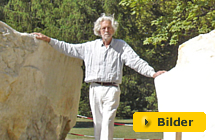
Mr. Wolfgang Kraker v. Schwarzenfeld as the initiator of the Global Stone Project in a meeting with his Excellency Lyonchen Jigmi Y Thinley, the Prime Minister of Bhutan, at the Gyalyong Tshogkhang in Thimphu on 7th October, 2009.
 
Any kind of help is welcome.
Warm regards to all stones’ friends,
Wolfgang K. v. S.
The Map of Bhutan with the capital city Thimphu and the pictures of stones in the riverbed.
  
  
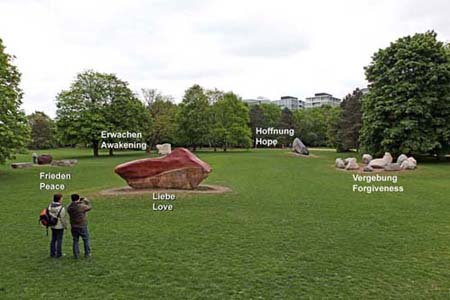
The location of the Global Stone Project in Tiergarten, Berlin
You will find the location near the Loewengruppe (Lions’ Group) in Tiergarten. With the Brandenburger Gate behind you, follow the “Ahornsteig” for about 300m. Or Potsdamer Platz, enter the Park near Sony Center and keep walking for about 250m.
For an interview or contact the initiator of this project :
Wolfgang Kraker von Schwarzenfeld
An der Aue 32
14552 Michendorf OT Wilhelmshorst
Germany
www.globalstone.de
mail@globalstone.de
Tel. : + 49 (0) 33 205 20345
Mobil : + 49 (0) 170 47 22 334


|